
Safety Data sheet
An SDS (Safety Data Sheet) is an official document that provides detailed information about a product’s chemical composition, potential hazards, safe handling procedures, storage requirements, and emergency response measures.
- Home
- /
- Safety Data sheet
What Is an SDS and Why It Is Required in Parcel Forwarding
At San Ysidro PO Box, we are committed to ensuring that all shipments are handled safely, efficiently, and in full compliance with international shipping regulations. As part of this process, you may occasionally be asked to provide a Safety Data Sheet (SDS), even for products that appear to be non-hazardous or commonly used.
An SDS (Safety Data Sheet) is an official document that provides detailed information about a product’s chemical composition, potential hazards, safe handling procedures, storage requirements, and emergency response measures. It is commonly required for items that fall under dangerous goods or restricted classifications under international transport regulations, especially for air and cross-border shipments.
We understand this requirement can sometimes be unexpected. This guide is designed to help you understand:
- What an SDS is
- Why certain products require SDS documentation
- Which types of items commonly trigger this requirement
Whether you are shipping electronics, cosmetics, automotive parts, or chemical-based products, understanding SDS requirements helps prevent delays, rejections, or returns and ensures your shipment moves smoothly through the forwarding process.
What Is an SDS?
An SDS (Safety Data Sheet) is a document that provides critical information about chemical substances or products, including:
- physical and chemical properties;
- health hazards;
- storage and handling requirement;
- transport classification (flammable, corrosive, etc.).
It’s designed to inform anyone who handles, ships, or uses a product – such as warehouse staff, shipping couriers, customs officers, and even end-users – about potential hazards and the proper way to manage the item safely.
Is SDS the Same as MSDS?
While the term “MSDS” (Material Safety Data Sheet) is still commonly used, most regions that follow the Globally Harmonized System (GHS) now refer to it as an “SDS” (Safety Data Sheet). The change reflects a move toward standardization and consistency in chemical safety documentation.
What’s Included in an SDS?
An SDS breaks down a product’s properties into multiple sections, but some of the key information includes:
Physical and Chemical Properties
Description of the product’s appearance, smell, boiling/melting point, flash point (flammability), and other physical traits that help identify the product and assess risks.
Health Hazards
Information on how the product could affect human health, such as causing irritation, allergic reactions, toxicity, or long-term effects from exposure (like carcinogenicity).
First Aid and Emergency Measures
Provides basic instructions on how to respond to different types of exposure, such as eye contact, ingestion, skin exposure, or inhalation.
Transport Classification
Details on whether the product is considered dangerous goods for shipping. This includes information such as:
- Flammability
- Corrosiveness
- Presence of pressurized gases, batteries, or hazardous chemicals
- The correct UN number and hazard class for international shipping
Storage and Handling Instructions
- Gives guidance on how to store and handle the product safely. Includes recommended:
- CorrosivStorage conditions (e.g., temperature, container type)eness
- Handling precautions (e.g., wear gloves, avoid sparks or open flames)
- Spill or leak response procedures
Full list of SDS standardized sections
A Safety Data Sheet (SDS) typically contains 16 standardized sections, organized to provide comprehensive information about a hazardous substance or chemical product. These sections are aligned with the Globally Harmonized System (GHS) of Classification and Labelling of Chemicals. The 16 Sections of an SDS are:
- Identification – Product name, manufacturer details, recommended use.
- Hazard(s) Identification – Physical, health, and environmental hazards.
- Composition/Information on Ingredients – Chemical ingredients and concentrations.
- First-Aid Measures – Initial care instructions for exposure.
- Fire-Fighting Measures – Extinguishing methods and hazards during fire.
- Accidental Release Measures – How to safely handle spills or leaks.
- Handling and Storage – Safe handling practices and storage conditions.
- Exposure Controls/Personal Protection – Recommended exposure limits and PPE.
- Physical and Chemical Properties – Appearance, odor, boiling point, etc.
- Stability and Reactivity – Chemical stability and possible reactions.
- Toxicological Information – Health effects and exposure risks.
- Ecological Information – Environmental impact (non-mandatory in some regions).
- Disposal Considerations – Safe disposal practices (non-mandatory in some regions).
- Transport Information – Shipping classifications and transport risks.
- Regulatory Information – Applicable safety, health, or environmental laws.
- Other Information – Revision dates, disclaimers, or additional notes.
Note: While all 16 sections are included in GHS-compliant SDSs, some (like sections 12–15) are not mandatory under OSHA in the US, but may be included for completeness.
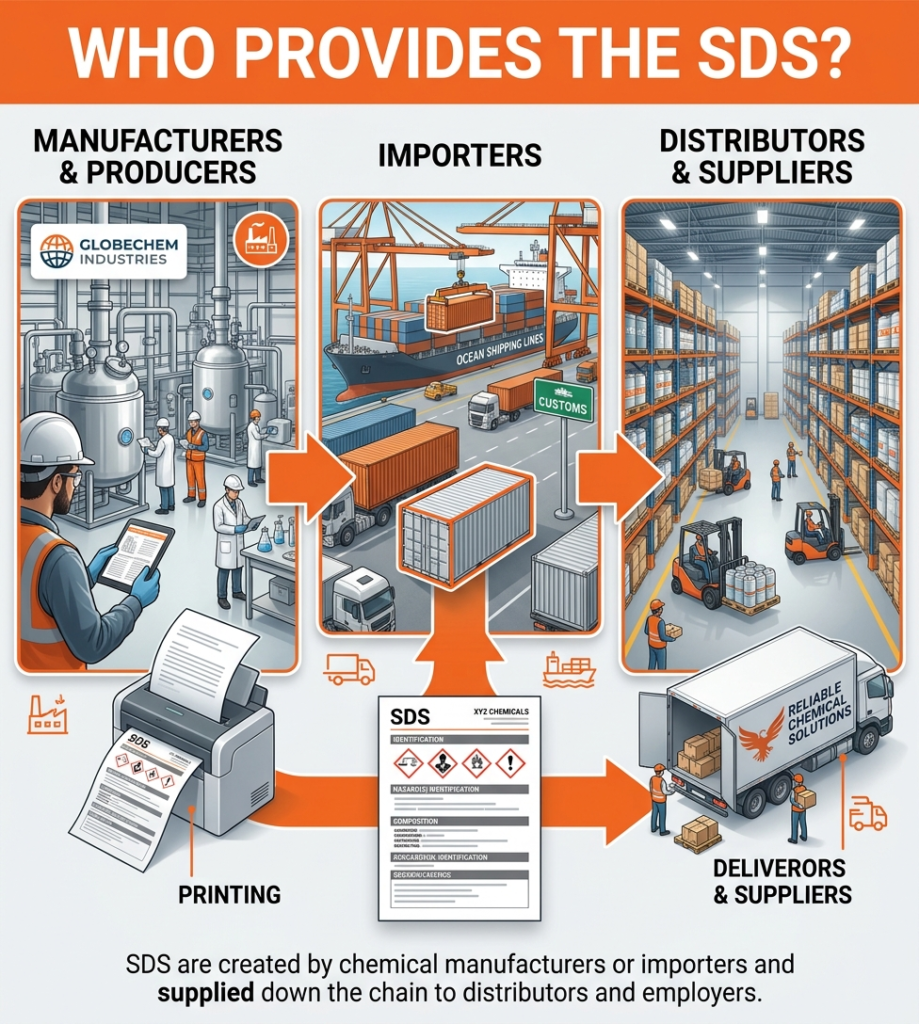
Who Provides the SDS?
The manufacturer, brand owner, or supplier of the product is responsible for creating and distributing the SDS. In most cases, especially with regulated goods, the SDS is available:
- on the product’s official website;
- from customer service upon request;
- packaged with large bulk orders or industrial shipments.
When Might You Be Asked for an SDS?
- 1. If the contents are unclear, or if customs/carriers flag the item as potentially dangerous.
- 2. If you're shipping certain products like:
- electronics with internal batteries;
- cosmetics or personal care products;
- household cleaners or automotive items
How to Obtain an SDS
If you’re required to provide an SDS (Safety Data Sheet), you can typically find it in the following ways:
Manufacturer or Supplier Website
Most companies that produce chemicals or hazardous materials host SDS on their websites. Look under sections like:
- “Safety Data Sheets”
- “Product Documentation”
- “Downloads” or “Support”
Try searching Google with [Product Name] + SDS site:[manufacturer’s website]
If it’s not online, call or email the supplier’s customer service or technical support department. They are required to provide SDS upon request.
SDS Databases
There are a few reputable online databases with thousands of SDSs:
- Chemical Safety
- MSDS
- VelocityEHS
What Happens Without an SDS?
- The package may be:
- Delayed
- Returned
- Destroyed
Important Notes
- Check SDS validity
- We recommend using the most recent version of the Safety Data Sheet – preferably one issued within the last three years.
- An older SDS may still be acceptable if the product’s composition and regulatory information have not changed.
- As a parcel forwarder, we can refuse to ship the item until the SDS is provided.
Which Regulations Require SDS
Several international regulations and standards require Safety Data Sheets (SDS), especially for hazardous chemicals or materials. Below is a breakdown of the main regulations by region, including what they cover and when SDSs are required:
Globally Harmonized System (GHS)
– Issued by: United Nations
– Scope: International standard adopted by many countries
– Requirement:
- SDS must accompany hazardous chemicals.
- SDS must follow a standardized 16-section format.
- Labels and SDS must be consistent.
Foundation for most other SDS regulations worldwide.
REACH Regulation (EC 1907/2006) & CLP Regulation
– Region: European Union
– Enforced by: European Chemicals Agency (ECHA)
– Requirement:
- SDS must be provided for substances classified as hazardous.
- Extended SDS required for substances with exposure scenarios.
- Follows GHS-aligned formatting under CLP (Classification, Labelling, and Packaging).
REACH adds substance registration and risk assessment requirements.
OSHA Hazard Communication Standard (HCS 29 CFR 1910.1200)
– Country: United States
– Enforced by: Occupational Safety and Health Administration (OSHA)
– Requirement:
- Employers must provide SDSs for hazardous chemicals in the workplace.
- SDSs must be accessible to employees.
- Follows GHS-aligned format.
Used for workplace safety, shipping, and labeling.
Industrial Safety and Health Law (ISHL)
– Country: Japan
– Enforced by: Ministry of Health, Labor and Welfare
– Requirement:
- DelayedSDS must be issued for over 600 specified substances.
- SDS must be in Japanese and follow local formatting based on GHS.
SDS & Transport Regulations by Mode
Air Transport – IATA (DGR)
– Issued by: United Nations
– Scope: International standard adopted by many countries
– Requirement:
- SDS must accompany hazardous chemicals.
- SDS must follow a standardized 16-section format.
- Labels and SDS must be consistent.
Foundation for most other SDS regulations worldwide.
REACH Regulation (EC 1907/2006) & CLP Regulation
– Region: European Union
– Enforced by: European Chemicals Agency (ECHA)
– Requirement:
- SDS must be provided for substances classified as hazardous.
- Extended SDS required for substances with exposure scenarios.
- Follows GHS-aligned formatting under CLP (Classification, Labelling, and Packaging).
REACH adds substance registration and risk assessment requirements.
Road Transport – ADR (Europe)
– Regulation: ADR (Accord européen relatif au transport international des marchandises dangereuses par route)
– Enforced by: UNECE
– SDS Role:
- Used to classify and prepare dangerous goods for road transport.
- Provides data needed for:
- Transport labels
- Transport category
- Tunnel restrictions
- ADR regulations specify packaging, placards, and vehicle markings.
Sea Transport – IMDG Code
– Regulation: International Maritime Dangerous Goods Code
– Enforced by: IMO (International Maritime Organization)
– SDS Role:
- SDS helps identify marine pollutants, flammability, and reactivity.
- Information extracted from SDS supports:
- Proper UN packaging
- Segregation requirements
- Stowage on vessels
Note: Marine pollutants must be identified per Section 14 of SDS.
Products That Usually Require an SDS
These are commonly flagged by couriers, customs, or forwarding warehouses due to their chemical content, flammability, or potential hazards.
Chemicals
Chemicals are one of the most tightly regulated product categories in international shipping. Even seemingly harmless items like cleaning sprays, industrial lubricants, or adhesives can pose risks during transit due to their flammable, toxic, or corrosive properties.
- Examples: Solvents, industrial cleaners, adhesives, detergents, acids, bases
Why an SDS Is Required:
- Many chemicals are classified as hazardous due to their flammability, corrosiveness, toxicity, or reactivity.
- SDS documentation is essential for accurately determining hazard classifications under transport regulations including
- IATA (for air),
- IMDG (for sea),
- ADR (for road in Europe),
- and DOT/HMR (for all domestic transportation in the United States).
- Shippers and forwarders need this info to apply proper labeling, use appropriate packaging (like UN-certified containers), and prepare shipping declarations.
An SDS provides detailed information about chemical composition, safe handling, and emergency procedures, all of which are necessary for the forwarder to classify the product correctly and comply with shipping regulations.
- Even small bottles of common chemicals may be restricted for air transport.
- Some can only be shipped via ground or sea.
- If you’re ordering from a supplier, request the SDS up front and send it to your forwarder in advance.
Flammable Products
- Examples: Perfume, nail polish, hair spray, aerosol deodorants, paint, alcohol-based cleaners
Why an SDS Is Required:
- Products containing alcohol or other volatile substances are classified as flammable liquids or gases.
- Flammable items are restricted or banned on many passenger aircraft.
- SDS helps determine flash point and other data needed for proper hazard labeling and customs declaration.
Shipping Tips:
- Even retail-sized containers (e.g., 50ml perfume) may be restricted.
- Some couriers accept small “limited quantity” shipments if properly packed. Consult before shipping.
- If the item is in an aerosol can, expect extra scrutiny.
Batteries (Especially Lithium)
- Examples: Smartphones, laptops, power banks, e-scooters, drone batteries, smartwatches
Why an SDS Is Required:
- Lithium batteries pose a fire risk if damaged, short-circuited, or improperly packed.
- International air cargo rules are especially strict for lithium-ion (rechargeable) and lithium-metal (non-rechargeable) batteries.
- MSDS outlines watt-hour ratings, UN numbers, and handling requirements.
Shipping Tips:
- Some countries prohibit uninstalled lithium batteries from entering by air.
- If you’re forwarding electronics, confirm whether the battery is installed or shipped separately, it makes a difference.
- Never try to ship damaged or swollen batteries.
Toxic, Corrosive, or Reactive Substances
- Examples: Pesticides, brake fluid, industrial degreasers, laboratory chemicals
Why an SDS Is Required:
- These substances can cause harm on contact or release dangerous fumes if spilled.
- The SDS is essential for emergency responders in case of leaks during transport.
- Forwarders use it to determine compatibility with other cargo and appropriate packaging materials.
Shipping Tips:
- These items often require UN-certified packaging and specific documentation.
- Some substances may require temperature control or isolation from other goods.
- Inform us in advance to avoid returns or confiscations.
Medical & Pharmaceutical Products
- Examples: Diagnostic test kits, vaccines, certain prescription medications, alcohol-based sanitizers
Why an SDS Is Required:
- Some medical products contain chemicals, alcohol, or biological material that may be regulated or restricted in transit.
- Products like diagnostic kits can include hazardous reagents, and biological specimens can fall under UN 3373 (Biological Substance, Category B).
- An SDS ensures the forwarder can identify any special handling needs, such as cold chain requirements or packaging standards, and comply with health and safety regulations.
Shipping Tips:
- Some medications are legal in one country but restricted or banned in others. SDS helps determine classification.
- If you’re shipping for research, medical, or lab purposes, prepare documentation in advance.
Miscellaneous or Surprising Items
- Examples: Printer ink, essential oils, strong magnets, automotive parts (e.g., airbag modules, fuel system components, shock absorbers), life jackets, inflatable dinghies, first aid kits
- Items that seem harmless may contain regulated substances or pose indirect risks:
- Magnets can interfere with aircraft instruments.
- Ink and toner can leak under pressure or heat.
- Car parts may contain fluids or explosive components like airbags.
- The SDS helps identify “hidden” hazardous materials and determine if shipping is possible, and under what restrictions.
- High-powered magnets (like neodymium) often need shielding to comply with IATA magnetic field limits.
- Car parts may be fine to ship if drained and cleaned but forwarders still need an SDS to confirm.
- Many essential oils are flammable and fall under Class 3 hazardous goods, so don’t assume they’re safe just because they’re natural.